Saturday, 20 February 2010

Sign of the times

Teachers practising the sign for chalk - it starts with pointing at white teeth (Ugandan sign language in case any of our readers speak British Sign Language)
Emmanuel and Hannah showing us how to do it properly

Practice makes perfect


We also, in what was a busy week, held sign language training for teachers at Kamwenge Primary School, which has a special needs unit attached with several deaf children. Great fun was had by all the participants as we learnt how to sign greetings and ask for local foods, amongst a wide range of topics. And of course most importantly how to ask for a beer! The workshop was lead by fellow VSO-er Hannah and was very interactive. We finished up with a soda and a cake and signed goodbyes. The costs were met by money from our Justgiving site, so many thanks to all who contributed.

At last - a school health workshop

Richard demonstrating how to make a tippy tap


Geoff wishes that he got this much concentration when he used to do assemblies!

A practical first aid demonstration


Headteachers working together to think of ways to improve health in their schools.

After weeks of planning and a few headaches due to funding issues, it was the day of our new training workshop, entitled ‘The Health Promoting School’. Although Sabrina has been working on health related issues in schools since we arrived and we have carried out several HIV/AIDS training workshops, this was the first 2 day training course for head teachers and teachers on health issues. The concept of ‘Health Promoting Schools’ is a fairly new one here and we had been concerned about how it would be received.

We are pleased to say the training went well and the teachers seemed to be interested and participated well. They all thought of ideas of improving the environment in their own schools and seemed to take on board the information about the importance of providing some sort on hand washing facility in school. One of our more motivated head teachers demonstrated how to make a tippy tap and told the participants how they worked in his school.

We talked about the importance of providing enough water to drink and making sure that children have enough food. Half of the children in our schools go all day without water or food because the school does not provide it and there is little at home. Anita, one of our colleagues from Kampala, came to talk about how to set up a school garden and we are hopeful that some communities will work together to provide some food, at the very least for the orphans and vulnerable children.

We also held sessions on a variety of health related topics and Geoff presented a session called ‘Guidance not Violence’ to give teachers some ideas on how to manage children in school without using corporal punishment. Although caning children is illegal in Ugandan schools, it is widely used as teachers have never known about other ways of managing behaviour. They seemed fascinated in Geoff’s information about ‘a child centered approach’ and ‘rewarding good behaviour’ and many asked for more information at the end.

It will of course be interesting to see how much of the information they take back to their schools and whether practice will change. As well as holding more workshops, we will be visiting schools to help head teachers implement what they have learnt.


Sunday, 7 February 2010

A glass half full moment!

Isaac has just gone into the final year of primary School, P7, and he helped me with the equipment.
We managed to get a couple of donations from VSO for the special needs unit in Kamwenge Primary School. The braille typewriter and paper we have already written about on the blog, but we also got a new wheelchair for one of the pupils with mobility problems. Here is a picture of them being presented to the children in the unit earlier this week. The girl who will be using the wheelchair had not yet returned to school, because her parents did not want her to go without a working wheelchair, so it is a very timely gift.

Is the glass half full or half empty?

Kamwenge has been visited by 2 Australians for the last couple of weeks – Tim and Sophie from Sydney. They are trustees of a local community based group, Toro Integrated Childcare and were visiting the project as part of a wider tour to report back to the other trustees in Australia. As is often the case when we have first time visitors to rural Africa, they asked how we managed to keep positive despite the poor school environment that Ugandan children have to learn in every day.

This got us thinking – how do we manage? Well, we think there are several answers to this question, although when we think about it, it is difficult.

  • Firstly after some time here we just accept that this is what school life is like for pupils and it is not in in our power to do anything about a lot of what they suffer. For example we cannot build new toilets in every school. We have to concentrate on those things that we can have an impact on, such as ensuring that good use is made of available water to provide hand washing facilities. It is only when a newcomer arrives that we see life through eyes that have developed-country standards.

  • We make a conscious effort to look for the positive elements that are happening – headteachers and teachers who are working hard in difficult circumstances and that we can work with to improve the education for their pupils.

  • We look for small steps of improvement and praise them. So when we are despairing, we think of those pupils who have set up rotas to fill the hand washing facilities daily and the head teachers who enthuse their staff and put the ideas they get at workshops into practice.

  • Lastly we concentrate on what we feel will make a difference in schools and to pupils’learning and work hard to empower what are known in the jargon as change agents – those who have the ability, the power and the respect to make changes for the benefit of children.

Not a very satisfactory answer, perhaps, but one that works for us.

Next week is our workshop for promoting healthy schools and we found it difficult to stay positive when one of our funders withdrew their money 7 days before. It was too late to cancel as we had already sent out the invites, bought the resources we were going to distribute and printed the participants handbook. So with some last minute juggling we managed to sort things out but it puts further workshops in jeopardy if we cannot replace the lost funds.

Of course when the going gets tough the tough go shopping, so here is Sabrina with the jerrycans to make hand washing facilities for the attending schools and cotton wool for the first aid kits we will be handing out!

Sunday, 31 January 2010

This is the last week of the long school holidays – since the beginning of December – and the new school year starts on Monday. We have been preparing for our ‘Promoting School Health’ workshop, which is taking place in the 2nd week of term. This has involved researching the internet, preparing lesson plans, priming other experts to lead sessions, writing a participants’ handbook and buying resources to hand out on the day. This is a new skill for both of us and we agonise over every part of the workshop to ensure it will be OK!

Most of the time we have locked ourselves in a spare office in the district education department and tried to ignore all the comings and goings. This was quite easy to do except for a couple of days this week when the place was crawling with anxious headteachers. Why? It was the day that the school results for Primary Leaving Exam (PLE) results came out. These are of critical importance for Ugandan schools as well as the district, as they are used to grade both of them, and it was like A levels, GSCE’s and SATs results day all rolled into one.

Children are graded from 1 (highest) to 4 (lowest) and each school hopes to get as many 1’s as possible. The size of the smile on a headteacher’s face gets bigger with every grade 1. Conversely those with none hurry out! We tell them that it is about children doing their best and reaching their potential, as well as trying to include the 50% of children who drop out before they even get to PLE, but it seems to fall on deaf ears at this time of year.

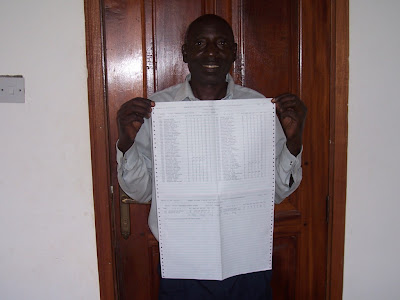
James from Rwengoro school got 4 1’s, so he is very happy!

Saturday, 23 January 2010

Flight to the hills


After a wonderful Christmas and New Year break in snowy Bicknacre (see our back garden above) catching up with friends and family, we are back in hot and sunny – well apart from the odd tropical thunderstorm – Uganda. The journey was very good and we were pleased to find that Kathy, an old friend of Sabrina’s that she did her nursing training with, was on our flight. In the too short time of the flight and over breakfast in Entebbe, they were able to do some catching up and exchange details of what they were doing. Kathy runs a charity called ‘BirthLink’, which provides support and education around the world for all those involved in the care of low birth-weight and sick babies.

After 2 days back in Kamwenge, we were invited by the District Education Officer, Eric, to go and visit his family home in Kisoro, in the far south-west (bottom left hand corner for those of you who slept during geography) of the country. It was an 8 hour drive and we climbed 2200 feet to get there but the scenery was stunning. Kisoro itself is in a bowl surrounded by mountains, with several large lakes around the town and we climbed to over 8000 feet, round a twisty steep road, to get over the lip of the bowl.

The area was formed by volcanic action and it is littered with caldera – extinct mini volcanoes as in this photo – that are all extensively farmed. This is because the area is very heavily over-populated as it is bordered by Rwanda and the Congo. Both of these countries have had internal conflicts in the recent past and many refugees have settled in Kisoro to escape the fighting. We went to the border with Rwanda and after shaking hands with the Rwandan border guards and smiling sweetly, were allowed to walk across and have our photos taken in front of the sign. We then walked back again! Still counts as a trip to another country in our book.

Sabrina was pleased to find this pub in Kisoro town. We are now back in Kamwenge preparing for the new term, which starts on February 1st.

Wednesday, 9 December 2009

Presenting the Perkins machine, a braille typewriter, to Julius, Chief Inspector of Schools and Kellon, the deputy headteacher of Kamwenge Primary School, where the unit is situated.
The local flea pit - well actually a mobile phone shop now, reflecting a major Ugandan interest.

Impressive hoe technique - all that time on the allotment obviously not wasted. Although there is a red cross volunteer very close behind just in case . . .


Dance techniques not as good as hoe techniques.


Volunteers Rob, from USA, and Wilson, a Ugandan who volunteered in Namibia.

We have had an eventful couple of weeks! Those of you who access Facebook will know that Sabrina managed to get bitten by a monkey whilst out with other volunteers in Fort Portal. The bite was tiny but no chances can be taken with rabies as it is 100% fatal. Fortunately we have both had a full course of rabies vaccination, but we still had to travel to Kampala for 2 extra injections just to make absolutely sure! Sabrina has decided she does not like monkeys any more!
Last week we went with VSO to Soroti, which is in the North-East of Uganda, as part of International Volunteering Week. We met up with volunteers from the Red Cross and UN and attended the events, which involved marching through Soroti town with a brass band and planting 250 tree seedlings! Soroti is quite different to Kamwenge, being mostly flat but with huge clumps of rocks jutting out of the ground. It is hotter and dryer as well. It was good fun and we enjoyed meeting up with volunteers from other organizations. Back in Kampala we attended a BBQ in the VSO garden which involved lots of food, drink, drumming and dancing and the next day we attended a party at a hotel where the volunteer of the year was announced (no, it wasn’t either of us!). All good fun.
We are now back in Kamwenge with only 1 week left until we go home for Christmas. Sabrina is preparing for a school health workshop that will be held at the start of the new term and Geoff is busy organizing some equipment and activities for Kamwenge Primary School’s special needs unit. He helped to get some specialist Braille equipment for the teachers of the blind and we have just listened to his dulcet tones as he was interviewed on ‘Voice of Kamwenge’ (our local radio station) evening news. Sabrina would also like to point out that she was on the news about 3 weeks ago as the guest of honour at a school prize giving but we did not find out until afterwards L.

Happy Christmas