Saturday, 25 September 2010

Water

Last week delegates were meeting in New York to discuss the progress on the Millennium Development Goals that were agreed in 2000. We read in the paper that Uganda has made good progress in reducing the number of people living in extreme poverty, but the poor progress on health still shocks us. We see that 137 children out of every 1000 born here still do not reach their 5th birthday. These figures are for the whole country. In poor, rural areas such as Kamwenge, the death rates are higher. More than 300 people, mostly women and children, die every day from malaria and there are over 80,000 AIDS related deaths registered every year. However the statistic that we find most shocking is that more children die from diarrhoea than anything else. Diarrhoea is caused by poor sanitation and the drinking of unsafe water. The problem sounds simple to solve, but we all have to come to terms with the fact that, at the end of 2010, most people here do not have access to clean safe water.

We have been inconvenienced over the last week because our piped water has stopped flowing. Our water comes from a small pumping station on the river Mpanga (about 10 Km from us). The reason for the stoppage is that the pumping station has had its electricity cut off. This is because most people who signed up for this water cannot pay their water bill and so the pumping station owners cannot pay for their electricity. We are fortunate because we can afford to pay a boda boda (motorcycle) driver to go and get us jerry cans of water from a gravity feed water system in another area. We also have a functioning rain-water collection tank. We then filter and boil the water to make it safe. Most people in Kamwenge, however, have to get all their water from the swamp or dirty shallow wells and cannot afford to filter and boil, so children continue to suffer from diarrhoea and continue to die.


In the 17 months that we have been here, we have worked hard to improve sanitation and hygiene in schools, have shown teachers how to make basic hand-washing facilities and stressed the importance of boiling water for drinking. However the challenge remains that until access to safe water improves for all, the long term improvment to health will be minimal.

Sunday, 12 September 2010

Eggxciting Spring Time


At the end of the school holidays, we went to visit the Hot Springs at Semliki National Park. These are ringed by forest, veiled in a cloud of steam and are a primeval sight. The largest spring is a geyser which can spout up to 2m high from the opening in the salt structure. As can be seen in the photo, it was about a metre high when we visited, but was still impressively hot and steamy. There are several other outlets which bubble away with boiling water and, in one of them, our guide left some eggs, which were nicely hard boiled after 7 minutes and made a welcome snack after the walk through the forest. For the sharp eyed amongst you, our Ugandan colleague provided the eggs in a Tesco egg box!

We have had some furniture made for the special needs unit, in conjunction with Rakel, the Spanish volunteer who left recently. The picture shows a walking rail (not sure of the technical term!) which can be used by the children with mobility problems to improve their posture whilst walking. We had to explain to the carpenter how to make this from scratch as he had never seen one before so there was a lot of trial and error before it was finished. But we are pleased with it and it seems to benefit the children.

We have now been connected to the grid and so get electricity on a fairly regular basis. It was good during the dry season, but now the wet season is starting, there are more power cuts due to heavy storms. However it is good enough for us to use an small oven left to us by Stuart and Sarah when they returned to Canada. We are having great fun making flapjacks and cakes – witness the carrot cake being removed from the oven. Sabrina would like to make lasagne and shepherd’s pie but we cannot get the ingredients here so they will have to wait until we return.

Pineapple Update
Following the positive comments we thought a regular update was necessary. The pineapple has some lovely little blue flowers and is growing apace.

Travel Guide Name Check
Geoff is apparently mentioned in the latest edition of the Bradt Travel Guide to Uganda – Page 329, Edition 6 if you feel you must rush out and buy it – following an email he sent to the author of the last edition about an attraction that is near us. Fame at last!!

Sunday, 29 August 2010

Bread and Pineapple


One of the projects set up by Stuart, the Canadian volunteer who recently left, was bread making. It is designed to provide extra income for widows and single mothers, and is run by a group of women who are associated with the Cathedral in Kamwenge. Stuart researched and built a ‘rocket oven’, so-called because when it is fired up and working it sounds like a rocket! It is designed to generate a lot of heat whilst using less firewood than usual cooking methods. It is certainly an impressive piece of kit, as can be seen from the picture.


But the best thing about it, from our point of view, is that Stuart taught the women to make bread that we like, rather than Ugandan bread, which is much heavier than our taste. So we buy some brown bread flour from the nearest large town, give it to the baker and order a loaf every 2–3 days. Sabrina has also made some marmalade from local oranges, so we have toast and marmalade for breakfast and feel very English!

On a lighter note we are very excited that one of our pineapple suckers, planted over a year ago in the tubs in our compound, has started to produce a little pineapple – small but perfectly formed, as you can see from the picture. Never mind about potatoes, tomatoes, and cucumbers and other temperate crops – growing a pineapple is the business!

Sunday, 22 August 2010

5 little ducks went swimming one day . . .

We have had a very busy time since our last blog entry (don’t we always say that).

Geoff’s maths workshop went really well and the teachers particularly enjoyed learning number rhymes and songs that they could use to teach the younger children mathematical concepts. As with all workshops, we wonder what impact they will have on pupil learning. We were thrilled a week later, when walking home one day, to hear some young children sitting outside their house and singing one of the songs we had taught at the workshop – ‘5 little ducks went swimming’ in case you’re interested! He also taught how to use number lines and followed it up with classroom visits.


Heather, daughter of our good friends, Brian and Ellen, visited us for 3 weeks and helped in the special needs unit at the local school. She is able to use British sign language and communicated with the deaf children, even though Ugandan sign language is slightly different from the British version. The pupils took great delight in teaching her the differences. We showed her the work we have done in some of our other schools and she was able to appreciate the joys of travelling on murram roads!


At the end of her stay we went on safari and saw, among other animals, 9 elephants drinking from the water, twin baby hippos, a huge crocodile and 12 lions (from a distance).


A jigger is a sand flea that lives in the dust of classrooms without proper floors and is a problem for pupils who go to school in bare feet. Stop reading now if you are eating. It burrows into the toes or feet and then lays its eggs under the skin. These hatch out a few days later and cause much pain and itchiness. It is usually OK if you wear sandals, however Sabrina found one in the end of her toe. Fortunately we were on our way to Kampala and so were able to get a volunteer doctor friend to remove it, on Saturday morning on her balcony, with an admiring audience of children and adults looking on. Thanks Alison. Sabrina and toe are recovering nicely.


On the way back from dropping Heather at the airport, we went to Masindi to visit Bollus, the headteacher who visited us in Bicknacre and who hosted Geoff when he first came to Uganda. We had a lovely time catching up on family news. His daughter, Bridget, a 15 year year old secondary student, came back to Kamwenge with us for a short visit. She was a delight, washing all her own clothes daily and telling us how she could kill, cut up and cook a goat for her family. So unlike a 15 year old girl in the UK! She was thrilled to be able to use our computer as she has very little opportunity to use one in her school. We were able to let her practise some of the things she had learnt theoretically at school.


Bollus, his wife Margaret and their 2 new grandchildren, Joylin and Comred Rooney.

Saturday, 10 July 2010

workshops, water and whole numbers


'Draw 4 things on your slate'


'Stick' energiser


'Counting' energiser


Working on numeracy with David and some older pupils


Last week we held our third Health Promoting School training session, so we have now trained the head teacher and the health teacher in all the 61 schools we work with in Kamwenge District. We made a big effort this time to do lots of energisers between sessions, as it gives the teachers ideas to make their own lessons more interesting for pupils. Most lessons we see tend to be mainly ‘chalk and talk’ with pupils sitting quietly at their desks and receiving the teachers’ ‘wisdom’. A quick trawl of the internet provided some exciting ideas such as:-
· Writing your name in the air with your finger, elbow, shoulder, nose and belly button!
· In deference to the world cup, passing an imaginary football equivalent to the answer to simple maths questions – 9 minus 9 always fools them!
· Raising and lowering a long stick together – see picture.

The next job is to visit the 20 schools that attended last week and follow up with them. Have they written an action plan? Are there any areas they need further input on? Have they used the first aid kit we gave them and is it accessible to all teachers? Has the tippy tap been put up and is it filled with water every day?

Not an easy task at the moment as we are in a drought – there has been no rain for over a month, bore holes are drying up and the new water pumping system cannot extract from the local river as the water level is too low. It even made the national news in Uganda. With no pumped water having been available for 2 weeks, we used the rain water tanks until that dried up. We were then given water from the local swamp, but it was too dirty for us, so we had to get a motor bike taxi rider (known as a boda) to get us jerry cans at 2000 ugandan shillings each. Only 70 pence but an awful lot for here. They were obtained from a gravity flow system, which is still working, about 10 Km outside town. We have stored several jerry cans and hope that supplies will trickle – literally! – through until the rains come.

In a mad moment Geoff volunteered to write a numeracy workshop for infant teachers and struggled to get on with it, infant maths not being his strongest point! On the basis that a deadline concentrates the mind wonderfully, he organised a trial training session for 2 weeks time and has found it helped greatly. He is getting internet information on number lines, maths’ stories, songs and rhymes, and problem solving, as well as trying to remember all the maths workshops he attended in Essex – thanks to Diana Rouse, maths subject leader at Stock Primary School for her training!

He has been discussing it with local teachers like David from Railway School, as you can see in the picture. David is a very reflective teacher and, following a visit to Ireland in 2008, tries out lots of ideas in his classroom as well as singing with Geoff in the cathedral choir!!

Saturday, 26 June 2010

Volunteer support


Dorota's farewell party with volunteers and friends in Kamwenge

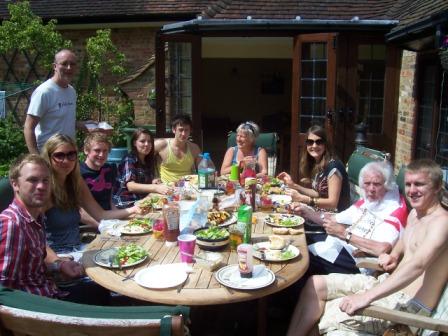
For those of you who may have wondered about the repeated jumble of photos last week - the group around the table were not animals in Lake Mburu National Park but our family in Pinner!!
One of the great things about being a volunteer in Uganda is meeting other volunteers. In the 14 months that we have been here (is it really that long?) we have met some truly amazing people. We have many volunteer friends in Kampala and other large towns, but the ones that make a huge difference to our lives on a daily basis are those few in Kamwenge.
When we first came here we were the only volunteers in this District. Within a few weeks we were joined by Dorota, a delightful Polish girl who had spent many years in Spain and was volunteering with a Spanish organisation called Africa Directo. Dorota’s organisation are building a much needed health centre in Kamwenge and her job was co-ordinating the project. Dorota quickly became a good friend and we shared scarce books and enjoyed many an evening drinking Nile beer and chatting. Sarah and Stuart came here from Canada just before Christmas and Rakel joined Dorota from Spain in January. Suddenly we were six and have been able to support each other, far from home, and also have fun together. Sarah and Stuart are a young Christian couple and have really made a difference to our lives at our local church.
Sadly Dorota’s time in Kamwenge came to an end in late May and she has now returned to Spain. We really miss her. Although Rakel, Sarah and Stuart will be leaving in August, we are fortunate that Goiko, a guy from Spain who has been a volunteer in Malawi for 2½ years, is coming to Kamwenge to move the health centre project on to its next phase. All of these (much younger than us) people have taught us so much and have made being a volunteer in remote Kamwege much more fun.

Sunday, 20 June 2010

Long overdue update


Lake Mburo boat trip


Impala in Lake Mburohttp://www.blogger.com/img/blank.gif

Sorry about the double pictures but decided we have better things to do than work out how to get rid of them!!!!

There has been a rather large gap between blog entries for many reasons, the main one being that Sabrina has been at home for 4 weeks and Geoff has been doing all his usual work, plus all the other jobs on his own that are usually shared.
Most of May was school holiday here, so we took the opportunity to visit other volunteer friends and do some sightseeing. We visited Lake Mburo National Park which is a small but delightful park and the only accesible location in Uganda where Zebra are found. As well as hippos and waterbucks, there are 315 species of birds. It is the best place in the country to see the ‘Bare-Faced Go-Away Bird’ so called because it has a bare face and the noise it makes sounds like it is saying ‘go away’!!! Although quite how it managed to speak English when the locals speak Ankole is a mystery? Lake Mburo is also the only reserve in the country to support a population of Impala, an antelope for which Kampala is named.
Sabrina had a wonderful time at home visiting family and friends and managed to catch some very good weather as well.
Geoff held more ‘Guidance not Violence’ workshops, which give teachers ideas of how to manage behaviour without resorting to corporal punishment. He also has prepared a 2 day training manual on numeracy for early years teachers, which he will trial with a small group of friendly teachers an make any necessary adjustments so it can be rolled out across other districts.
Kamwenge, like England and the rest of Africa, is currently in the grip of world cup fever. All the bars have big crowds, although sometimes support can be esoteric. The other day Geoff met a local supporting Japan instead of their African opponents because he owned a Japanese car! Anyway the cross of St George is hung in the bar next door for England games and Geoff has managed to gather a small goup of Ugandan England supporters around him who cheer England on – with more success in the future we hope.